
Who We Are
Diaspora Thredz is a creative studio and cultural design house that reclaims and reimagines fashion, identity, and ancestry across the African diaspora. We specialize in costume design, textile exploration, and storytelling rooted in pre-colonial traditions, contemporary drag, and Black queer expression.

Founded on the belief that clothing is both armor and archive, Diaspora Thredz blends art, history, and activism to craft garments and installations that speak to a deeper legacy of resistance and radiance
Drag in Diaspora
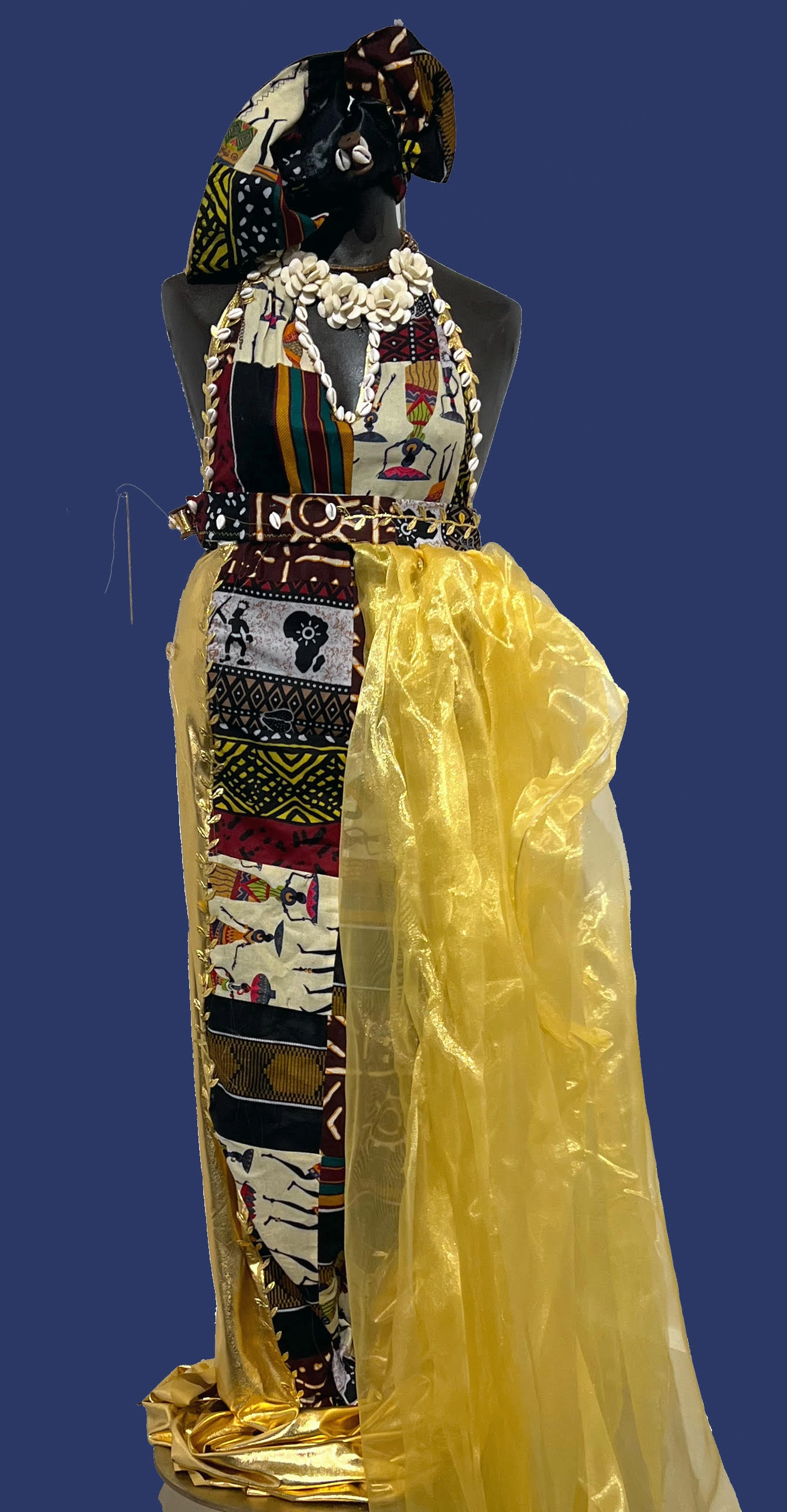
Drag in Diaspora is a conceptual textile and performance art installation exploring migration, lineage, gender fluidity, and ancestral reassembly through stitch.
Rooted in pre-colonial spiritual traditions and diasporic memory, the work reclaims fabric as archive and drag as sacred embodiment. Each garment functions not merely as costume, but as living document — layered with history, rupture, survival, and return.
The project examines how displacement shapes identity. Thread becomes both wound and repair. The needle becomes instrument of authorship. The body becomes site of ceremony.
Across Yoruba, Igbo, Akan, and other West and Central African traditions, divinity was not confined to rigid binaries. Deities and spiritual forces often embodied multiplicity, transformation, and liminality. Colonial intervention disrupted many of these systems, narrowing gender constructs and severing visible ties to ancestral frameworks.
Through large-scale constructed gowns, textile interventions, and performance-based activations, Drag in Diaspora investigates:
The survival of pre-colonial gender fluidity across the African diaspora
The erasure and reconstruction of lineage
The politics of adornment
The sacred architecture of drag
The work resists spectacle for spectacle’s sake. Instead, it positions drag as ancestral technology — a method of reconstituting what was fragmented.
Each piece is constructed through layered textiles, symbolic stitching, and diasporic reference points that trace routes across Africa, the Americas, and Europe. The garments hold memory. They carry migration. They refuse containment.
Drag in Diaspora is both exhibition and invocation.
It is not simply worn — it is inhabited.
Commissions and Collaborations
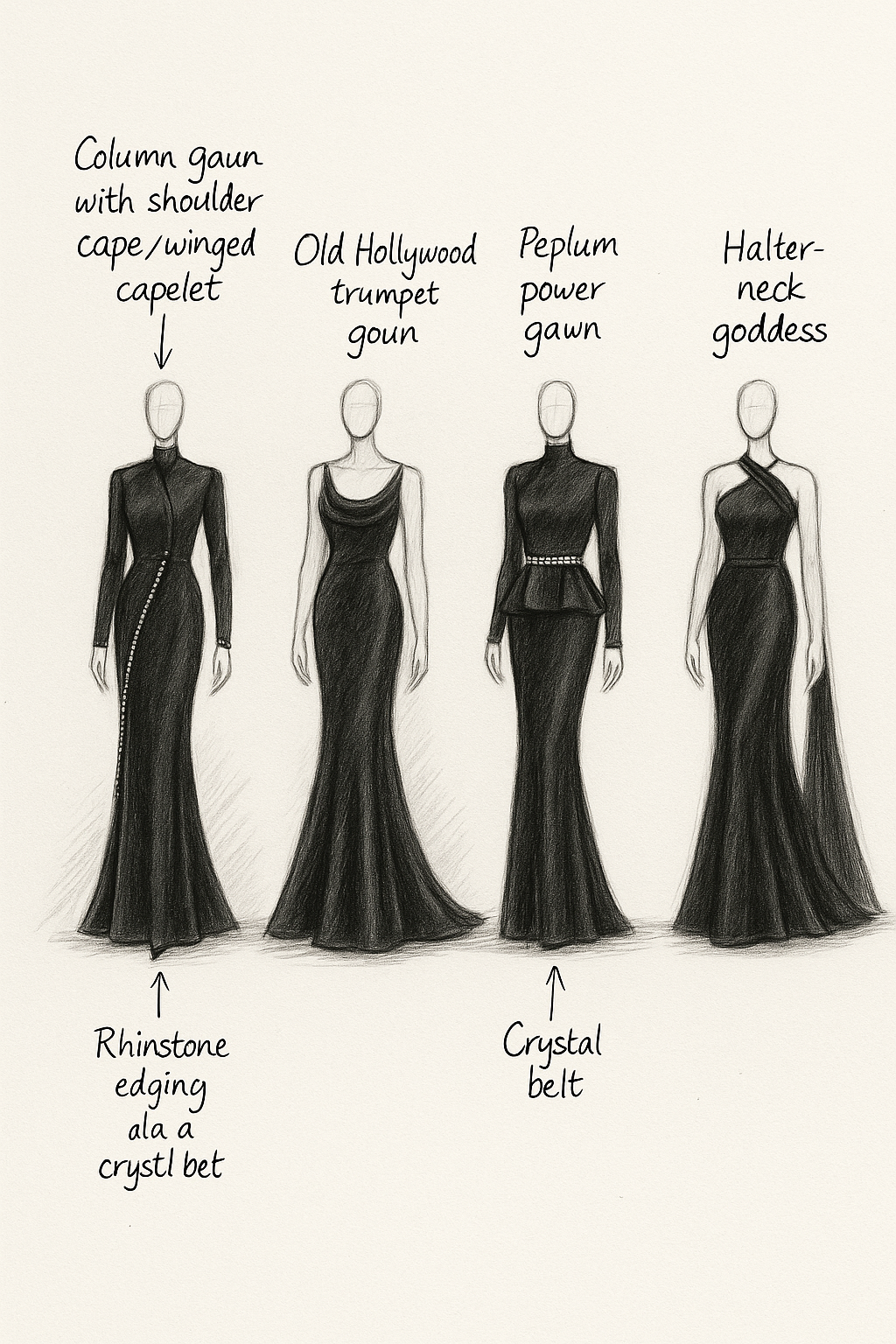
A strategic design session for performers, artists, scholars, and creatives seeking clarity around concept, symbolism, and aesthetic direction.
Includes:
60–90 minute virtual or in-person consultation
Cultural & historical research references
Mood board (digital PDF)
Silhouette & fabric direction
Performance context integration (stage, gallery, pageant, etc.)
Written concept summary for grant or program use (if needed)
Investment:
$150 – Single Session
$350 – 3-Session Concept Development Package
Consultation Credit:
If a design or construction contract is signed within 30 days, 50% of the consultation fee will be credited toward the final project cost.
Best for: performers refining a look, grant proposals, gallery planning, or spiritual/ancestral concept work.

From vision to stage.
Includes:
Full consultation + concept development
Custom rendering
Fabric sourcing
Pattern drafting
Construction
One fitting (local clients)
Styling guidance
Investment Starting At:
$1,200 – Performance Look
$2,000 – Couture Gown
$2,800+ – Gallery/Installation Piece
Final pricing determined after consultation based on materials, complexity, and timeline.
Rush orders available at +25%

For museums, galleries, academic programs, and cultural institutions.
Includes:
Concept development
Historical research integration
Installation sketching
Fabric studies
Narrative writing
Custom quote provided upon inquiry.
🖤 Payment Structure
50% non-refundable deposit is required to begin
Remaining balance due before delivery
Payment plans available for projects over $1,500
From Roots to Recipes Parts of Me
Pre-sale orders are being taken now.
Ship Date June 19, 2026

From Roots to Recipes
This cookbook exists because our ancestors refused to disappear.
Colonization attempted more than territorial conquest. It attempted erasure of language, ritual, land stewardship, spiritual systems, and kinship structures. It severed people from the soil. It criminalized the ceremony. It renamed the ingredients. It rewrote geography.
But it could not extinguish knowledge carried in the body.
African culinary customs survived the Middle Passage, plantation economies, missionary rule, forced migration, and economic displacement because they were portable. Techniques lived in muscle memory. Spice ratios were stored in instinct. Seeds were hidden in braids, pockets, and hems. Fire became a classroom. The kitchen became an archive.
Under colonization, cooking became a strategy.
Communal meals preserved social structure when family systems were fragmented. Shared pots maintained dignity when rations were meager. Adaptation turned scarcity into innovation. What was dismissed as “peasant food” became architecture for endurance.
Food became both shield and signal.
It encoded ancestry when names were stripped. It preserved agricultural science despite the theft of land. It carried flavor memory across oceans and generations. What empire tried to standardize, the kitchen diversified.
These meals are familial because survival required interdependence.
They are communal because isolation was imposed.
They are celebratory because joy became resistance.
They are empathic because care was the currency that endured.
From Roots to Recipes honors the culinary intelligence that outlived empire. It recognizes African foodways not as relics of the past, but as living systems of resilience — systems that fed bodies, stabilized communities, and kept memory intact when everything else was under assault.
To cook these recipes is not nostalgia.
It is a continuation.
🌍 Coconut Jollof Risotto with Berbere-Seared Shrimp
A West African × Italian Diasporic Fusion
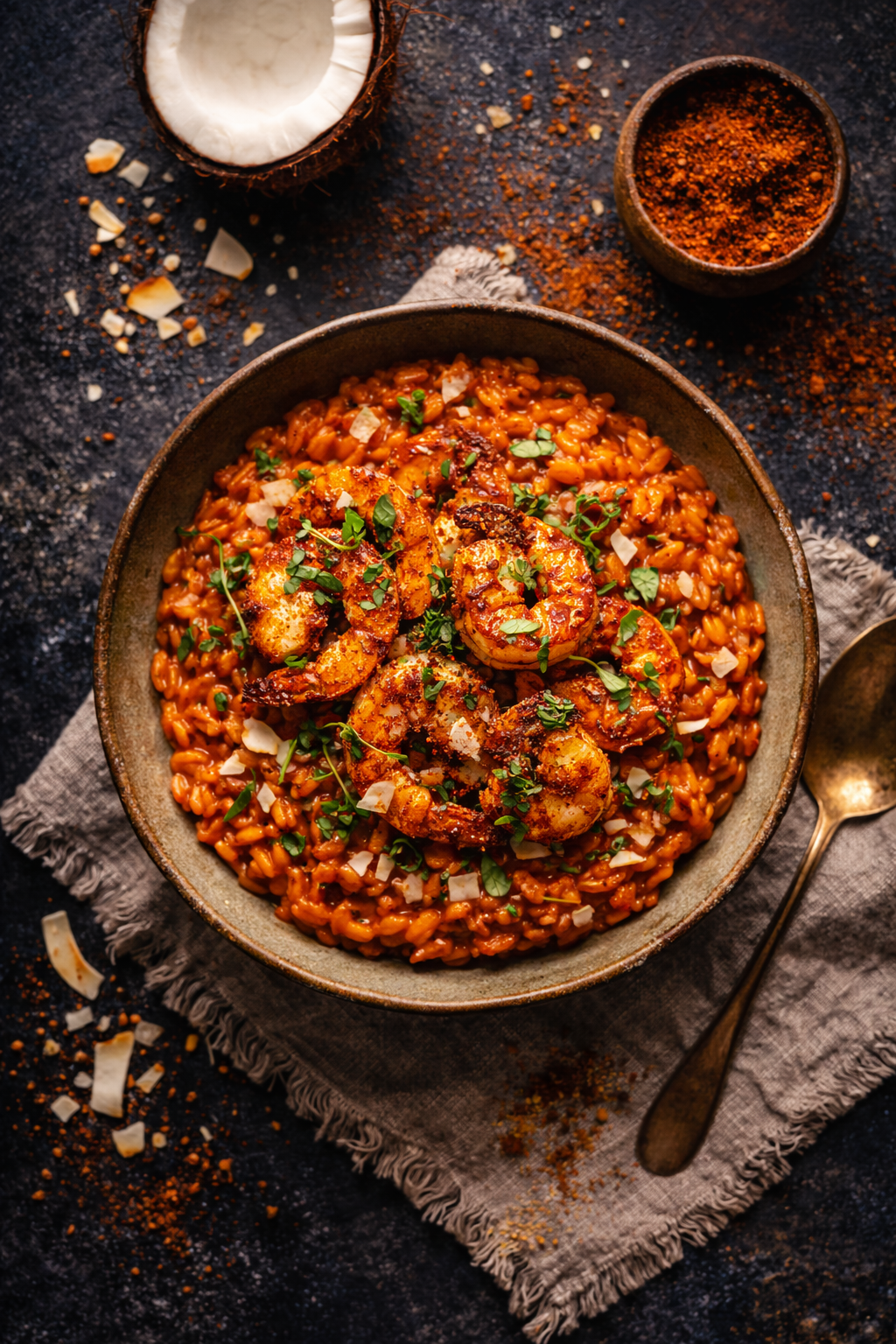
This dish marries the bold, tomato-forward base of Jollof rice with the creamy technique of Italian risotto, finished with Ethiopian berbere-spiced shrimp. It speaks to migration, trade routes, and spice circulation — Africa meeting the Mediterranean in one bowl.
Ingredients
Coconut Jollof Risotto Base
1 cup arborio rice
2 tbsp olive oil
½ small yellow onion, finely diced
2 cloves garlic, minced
1 tsp fresh grated ginger
½ cup crushed tomatoes
1 tbsp tomato paste
1 tsp smoked paprika
½ tsp thyme
1 cup coconut milk
3–4 cups warm vegetable or chicken stock
Salt to taste
1 tbsp butter (optional, for finish)
Berbere Shrimp
1 lb large shrimp, peeled and deveined
1 tbsp berbere spice blend
1 tsp lemon juice
1 tbsp olive oil
Pinch of sea salt
Garnish
Fresh chopped parsley or cilantro
Toasted coconut flakes
Microgreens (optional)
Instructions
Step 1 – Build the Base
Heat olive oil in a heavy-bottomed pan.
Sauté the onion until translucent.
Add garlic and ginger — cook until fragrant.
Stir in arborio rice and toast for 1–2 minutes.
Step 2 – Layer the Flavor
Add tomato paste and crushed tomatoes.
Cook until deepened in color.
Begin adding warm stock ½ cup at a time, stirring continuously—allowing it to absorb before adding more.
Once halfway cooked, stir in coconut milk, smoked paprika, and thyme.
Continue adding stock and stirring until rice is creamy yet al dente (about 18–22 minutes).
Finish with butter (optional).
Step 3 – Sear the Shrimp
Toss shrimp with berbere, lemon juice, and olive oil.
Sear in a hot pan 2–3 minutes per side until opaque and slightly charred.
Step 4 – Plate with Intention
Spoon risotto into a shallow bowl.
Top with berbere shrimp.
Garnish with toasted coconut and herbs.
Contact Us
Interested in working together? Fill out some info and we will be in touch shortly. We can’t wait to hear from you!